
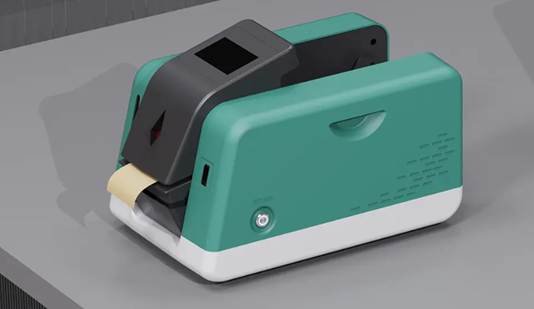
There is a moment in a growing packing operation when the bottleneck stops being the number of packers and starts being the number of motions each packer makes. Tape is a small part of that motion, but it repeats on every carton, and repetition is where automation earns its keep. A tape dispenser automatic system removes the feed, moisten, and cut sequence from the operator’s hands and turns it into a machine cycle — and in doing so, changes what the operator can pay attention to.
That reframing matters because it explains why automation helps some operations and disappoints others. The benefit is not simply speed. It is the removal of a variable that used to depend on human rhythm.
Where the Manual Sequence Breaks Down
With water-activated kraft tape, the manual sequence has three steps that must happen in the right order: pull the tape, wet the starch adhesive, cut cleanly. On a handheld unit like the GHC-50 — an 80 ml reservoir, a moistening brush, a blade, 50 mm tape width, roll diameters up to 140 mm — all three depend on the operator. A steady pull gives the brush time to transfer moisture evenly; a hurried pull leaves dry patches that lift within hours. The unit is genuinely useful for flexibility, but it depends on technique.
The NT-800 bench unit shifts part of that sequence to a lever: the operator sets a length, pulls, and the machine feeds, moistens, and cuts in one motion. It supports tape widths from 20 to 100 mm, custom lengths up to 1000 mm, and roll diameters up to 200 mm, with one water fill covering roughly 100 to 200 standard cartons. This is the point where length standardization stops depending on operator judgment.
The Automatic Tier and Its Two Variations
Above the lever bench sits the genuinely automatic tier, and it splits into two approaches.
The NT-AT 3.0 is the preset-length model. It dispenses at 60 m/min, holds a 3.5 L water tank, and runs below 75 dB at shutoff. The larger tank is less about capacity than about continuity — fewer mid-shift refills means fewer moments where moisture levels drift while someone tops up the reservoir. At 60 m/min, a one-meter strip dispenses in roughly a second, which changes the pacing of a packing station rather than just the speed of one step.
The Tape-AT is the sensor variant. It triggers on hand proximity rather than a button press, dispensing at an average of 60 m/min with a 2.5 L tank and adjustable water temperature from 0 to 80°C. The 45-degree case angle is set to reduce shoulder strain during long shifts. The practical case for sensor triggering is specific: it helps where the operator is holding a carton steady with one hand and cannot comfortably reach a button with the other. Where cartons lie flat during sealing, the button model works just as well.
The Warm Water Question
Buyers often ask whether adjustable water temperature is worth having. The answer depends on the room. Starch adhesive activates more readily in warm water, and in an unheated warehouse in winter that difference shows up in how quickly the tape grabs the carton surface. In a climate-controlled packing area the effect is smaller. It is a feature that matters in specific conditions rather than universally.
The Accessory That Fixes Estimating
The UM-CJ01 tape length detector measures a carton placed near it and calculates the required tape length, with detection distance from 3 to 200 cm and accuracy within 1 cm. It is compatible with the NT-ATv2.0. Manual estimation produces two losses that rarely appear in a cost report: tape cut short, requiring a second piece that weakens the seal, and tape cut long, wasting material on every carton. The second accumulates quietly across thousands of cartons.
The Threshold Test, Stated Plainly
The question buyers most want answered is when to move from manual to automatic. The useful measure is cartons per shift on the busiest day, not the weekly average.
A steady, moderate count is workable with the NT-800, which standardizes tape length without electronics and requires less maintenance attention. Operations sealing in the thousands per day will find the manual lever becomes a physical constraint before the shift ends, and that is the point at which the NT-AT 3.0 or Tape-AT justifies its cost. Buying automatic capacity ahead of actual volume adds maintenance burden without adding throughput — a common and avoidable mistake.
Verification Before Volume Production
Whatever model is chosen, test it on a dozen cartons and inspect the seals after the adhesive has fully dried — a few hours, or overnight for a proper check. Look for even darkening across the tape width, no pale dry patches along either edge, and corners that stay down when the flap is flexed. This test also reveals a ragged blade, which tears tape during application and creates a weak point at the seam.
Maintenance Realities
Three routines prevent most problems on any dispenser in this category. Rinse the moistening brush weekly to clear dust and adhesive residue. Empty the reservoir before extended idle periods to avoid stagnant water. Clear paper scraps from the blade area, since fragments misalign cuts. On automatic units, also confirm the water temperature setting is appropriate to the room — a setting left over from summer can over-warm water in an already warm packing area.
For Distributors and Resellers
A tape dispenser automatic unit is one part of a sourcing decision. Spare parts availability, warranty terms, and OEM/ODM flexibility determine whether a product line remains viable after the first order. Air Power Pak offers customization on selected models, including logo printing and body color, with minimum order quantities and lead times that vary by model and project requirements. Sourcing dispensers and compatible kraft tape from one supplier simplifies matching and replenishment, but tape specifications should be confirmed before bulk orders.
The decision sequence is consistent: confirm tape width and roll diameter against the dispenser’s supported range, count cartons on the busiest shift, test dried seals on real cartons, and then select the operating style that matches how the station actually runs. Automation is the right answer when the volume is already there — not a way to create it.